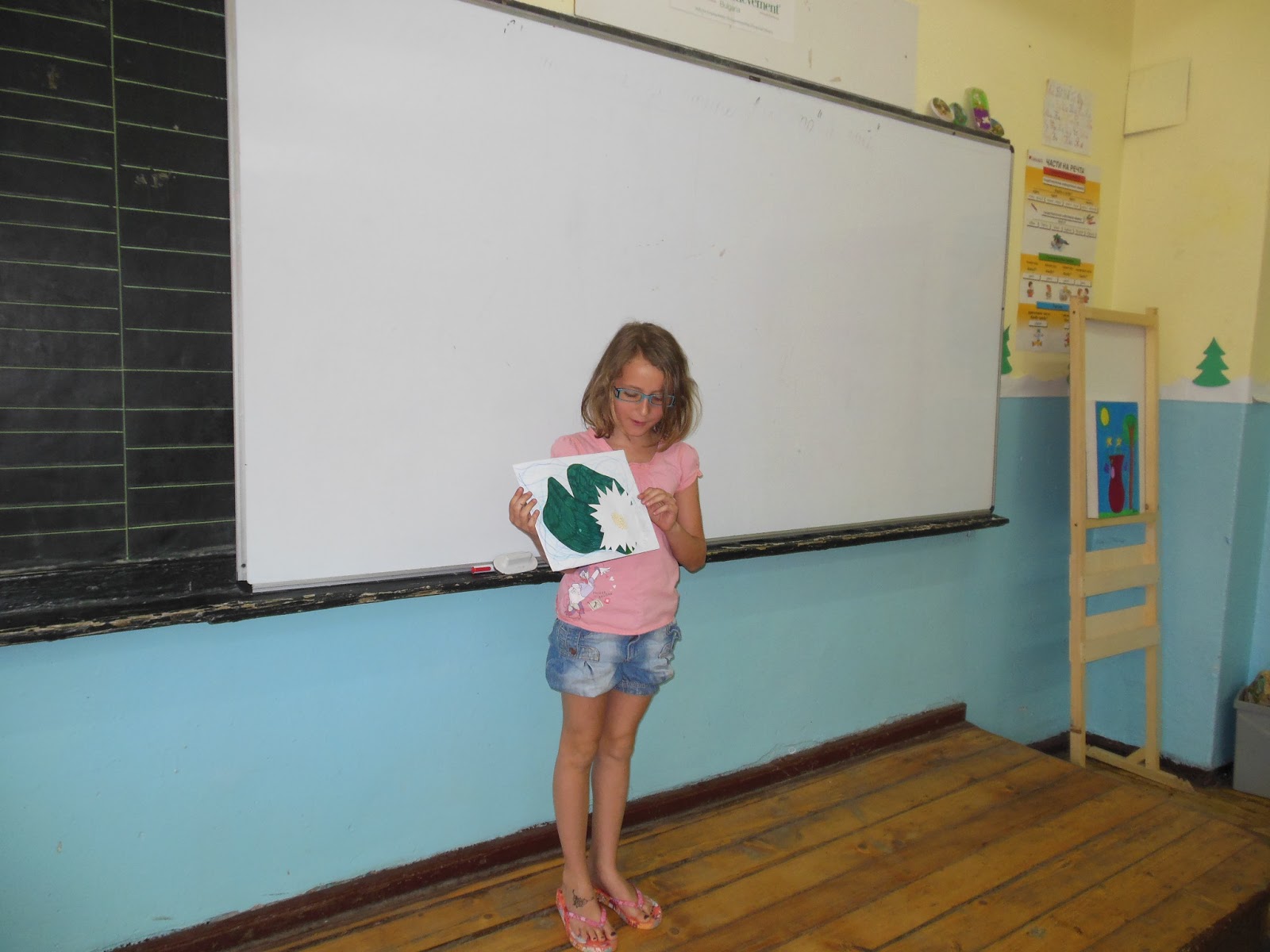
Nymphaea alba, also known as the European White Waterlily, White Lotus, or Nenuphar, is an aquatic plant.
It grows in water from 30-150 centimeters deep and likes large ponds and lakes. The leaves can be up to thirty centimeters in diameter and they take up a spread of 150 centimeters per plant. The flowers are white and they have many small stamens inside.
It is protected and increasingly rare plant.
Бялата водна лилия е от семейство Водни рози. Тя е водно растение, обитаващо спокойни водоеми с дълбочина от 30 до 150 cm. Листата и достигат 30 cm в диаметър и могат да се разпрострат в радиус от 75 cm по повърхността на водата. Едно от най-красивите водни цветя.
У нас тя е защитено и все по-рядко срещащо се растение.
Sylviya 4b and VIKI 3g




 Who doesn't know the stork?
Storks are large, long-legged, long-necked wading birds with long, stout bills.
Most storks eat frogs, fish, insects, earthworms, small birds and small mammals.
Their nests are often very large and may be used for many years.
Distribution in Bulgaria
So far in Bulgaria are performed three official censuses as follows 1979/84, 1994/9, and the last held in 2004 - In 2005 it counted 4,818 pairs are
District Sofia-city
1979/84 - 147 storks
1994/95 - 85 storks
2004/05 - 101 storks
Who doesn't know the stork?
Storks are large, long-legged, long-necked wading birds with long, stout bills.
Most storks eat frogs, fish, insects, earthworms, small birds and small mammals.
Their nests are often very large and may be used for many years.
Distribution in Bulgaria
So far in Bulgaria are performed three official censuses as follows 1979/84, 1994/9, and the last held in 2004 - In 2005 it counted 4,818 pairs are
District Sofia-city
1979/84 - 147 storks
1994/95 - 85 storks
2004/05 - 101 storks
